Testpassport

 sales@testpassport.jp

下記はBluePrism ASD01試験問題集は実際の試験問題のバージョンの一部です。 Solution Designer ASD01問題集 は実際の試験問題バージョンには27問になります。すべての実際の試験問題は、勉強者が最初の試みで成功することを保証できます。ASD01問題集の実際の試験問題でBluePrism試験に不合格になった場合、全額で支払い手数料の払い戻しを受けられます。実際の試験問題をトレーニングしたいでしょうか? では、トレーニングしましょう!

 ASD01フルバージョンを入手

問題#1

Imagine you are designing the application integration logic for a solution. One of the applications involved is one you have not automated before but it is widely used and the project is the first in a series for this client.
Which of the following are valid considerations when designing business objects? (Choose two.)

A. It’s best that objects are designed to be reusable and are not made bespoke for one process.
B. The first Production process to automate an application should not share its integration logic with any other because there will invariably be teething problems during an initial implementation.
C. When an application is automated for the first time a single business object should be used to isolate the first process from any that follow.
D. Any new application should be assessed to find the appropriate integration technique and identify any potential technical issues.
E. It’s best that each process uses its own business objects to keep it separate from any other.

問題#2

Consider the following steps for a theoretical manual process.
- Check in input folder any new files.
- If there are no files check again later as files can arrive anytime, and there is no limit to the number of files that may come.
- Open the next available file.
- Take the first case.
- Start System X and find the case details.
- If the case can’t be found, move to the next one.
- After finding the case in System X, fetch additional case details from System Y.
- Again if the case can’t be found, move to the next one.
- Analyse all the data to see if System Z should be updated.
- If the data does not meet the requirements, add notes indicating this to System X and Y and move to the next case.
- If the data does meet the requirements, update the case in System Z.
- Add notes to System X and Y and move to the next case.
- At the end of the file, go back and look for another.
- Stop checking for new files at 16:00 and finish any remaining cases.
- When all work is complete create a report of the day’s exception cases.
- Close down Systems X, Y and Z.
It is imperative that notes are applied to System X and Y, regardless of whether System Z is updated or not, what could the process do? (Choose two.)

A. Add all notes before attempting to update System
B. Create an unhappy path where notes are added as part of exception handling.
C. Add notes before rejecting a case as a Business Exception.
D. Create new cases for any cases not found in Systems X and Y so that notes can be added.

問題#3

Consider the following steps for a theoretical manual process.
- Check in input folder any new files.
- If there are no files check again later as files can arrive anytime, and there is no limit to the number of files that may come.
- Open the next available file.
- Take the first case.
- Start System X and find the case details.
- If the case can’t be found, move to the next one.
- After finding the case in System X, fetch additional case details from System Y.
- Again if the case can’t be found, move to the next one.
- Analyse all the data to see if System Z should be updated.
- If the data does not meet the requirements, add notes indicating this to System X and Y and move to the next case.
- If the data does meet the requirements, update the case in System Z.
- Add notes to System X and Y and move to the next case.
- At the end of the file, go back and look for another.
- Stop checking for new files at 16:00 and finish any remaining cases.
- When all work is complete create a report of the day’s exception cases.
- Close down Systems X, Y and Z.
If it is possible that there are long intervals between files arriving, what are the alternatives the process should take to control System X, System Y and System Z? (Choose two.)

A. Nothing because they will not have been started if no files have arrived yet.
B. Nothing, just leave them logged in until more work arrives.
C. Minimize them to keep the desktop clear.
D. Close Y and Z down but keep X open because it is the first application needed to work a case.
E. Log out while waiting and log back in when a file arrives.
F. Stop them from timing out by keeping them active while waiting for files.

問題#4

Consider the following steps for a theoretical manual process.
- Check in input folder any new files.
- If there are no files check again later as files can arrive anytime, and there is no limit to the number of files that may come.
- Open the next available file.
- Take the first case.
- Start System X and find the case details.
- If the case can’t be found, move to the next one.
- After finding the case in System X, fetch additional case details from System Y.
- Again if the case can’t be found, move to the next one.
- Analyse all the data to see if System Z should be updated.
- If the data does not meet the requirements, add notes indicating this to System X and Y and move to the next case.
- If the data does meet the requirements, update the case in System Z.
- Add notes to System X and Y and move to the next case.
- At the end of the file, go back and look for another.
- Stop checking for new files at 16:00 and finish any remaining cases.
- When all work is complete create a report of the day’s exception cases.
- Close down Systems X, Y and Z.
If the volume of incoming cases is such that 1 Resource PC can easily handle the workload, which of the following steps for an automated solution should be part of the ‘Preparation’ phase of an automated process?

A. Check input folder, wait for files.
B. Check input folder, wait for files, read file and load queue.
C. Log into applications.
D. Check input folder, wait for files, read file and load queue, log into applications.

問題#5

Consider the following high-level design.
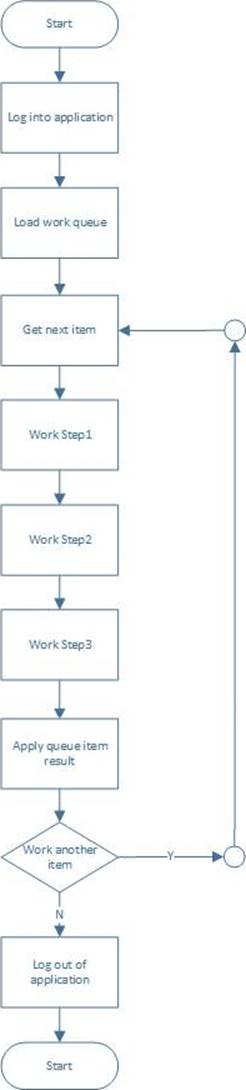


The application concerned is prone to being sluggish or even unresponsive at times. As the solution designer you should anticipate that there will be system exceptions and that after an exception case the application might not be in an ideal state.
What should you do? (Choose three.)

A. Add ‘clean up’ logic to get the application in the right position after Apply Queue Item Result.
B. Kill the application after each case and log back in to ensure the next case starts in the right position.
C. Instruct the developer to build objects capable of navigating the application back to the home position.
D. Restart the application if attempts to navigate back to the home position fail.
E. Move Log Into Application to be before Work Step1 and move Log Out of Application to be after Step3.
F. Add ‘clean up’ logic to get the application in the right position before Work Step1.
G. Add ‘clean up’ logic to get the application in the right position after Work Step1.

試験コード: ASD01問題数量: 27 Q&As更新時間:  2026-10-05

  ASD01フルバージョンを入手