Testpassport

 sales@testpassport.jp

下記はMicrosoft 70-767試験問題集は実際の試験問題のバージョンの一部です。 MCSE 70-767問題集 は実際の試験問題バージョンには136問になります。すべての実際の試験問題は、勉強者が最初の試みで成功することを保証できます。70-767問題集の実際の試験問題でMicrosoft試験に不合格になった場合、全額で支払い手数料の払い戻しを受けられます。実際の試験問題をトレーニングしたいでしょうか? では、トレーニングしましょう!

 70-767フルバージョンを入手

問題#1

HOTSPOT
You manage an inventory system that has a table named Products. The Products table has several hundred columns.
You generate a report that relates two columns named ProductReference and ProductName from the Products table. The result is sorted by a column named QuantityInStock from largest to smallest.
You need to create an index that the report can use.
How should you complete the Transact-SQL statement? To answer, select the appropriate Transact-SQL segments in the answer area.


A. 

問題#2

Note: This question is part of a series of questions that use the same scenario. For your convenience, the scenario is repeated in each question. Each question presents a different goal and answer choices, but the text of the scenario is exactly the same in each question in this series.
You have a Microsoft SQL Server data warehouse instance that supports several client applications.
The data warehouse includes the following tables: Dimension.SalesTerritory, Dimension.Customer, Dimension.Date, Fact.Ticket, and Fact.Order. The Dimension.SalesTerritory and Dimension.Customer tables are frequently updated. The Fact.Order table is optimized for weekly reporting, but the company wants to change it daily. The Fact.Order table is loaded by using an ETL process. Indexes have been added to the table over time, but the presence of these indexes slows data loading.
All data in the data warehouse is stored on a shared SAN. All tables are in a database named DB1. You have a second database named DB2 that contains copies of production data for a development environment. The data warehouse has grown and the cost of storage has increased. Data older than one year is accessed infrequently and is considered historical.
You have the following requirements:
You are not permitted to make changes to the client applications.
You need to optimize the storage for the data warehouse.
What change should you make?

A. Partition the Fact.Order table, and move historical data to new filegroups on lower-cost storage.
B. Create new tables on lower-cost storage, move the historical data to the new tables, and then shrink the database.
C. Remove the historical data from the database to leave available space for new data.
D. Move historical data to new tables on lower-cost storage.

Explanation:
Create the load staging table in the same filegroup as the partition you are loading.
Create the unload staging table in the same filegroup as the partition you are deleteing.
From scenario: Data older than one year is accessed infrequently and is considered historical.
References: https://blogs.msdn.microsoft.com/sqlcat/2013/09/16/top-10-best-practices-for-building-a-large-scale-relational-data-warehouse/

問題#3

Note: This question is part of a series of questions that use the same scenario. For your convenience, the scenario is repeated in each question. Each question presents a different goal and answer choices, but the text of the scenario is exactly the same in each question in this series.
You have a Microsoft SQL Server data warehouse instance that supports several client applications.
The data warehouse includes the following tables: Dimension.SalesTerritory, Dimension.Customer, Dimension.Date, Fact.Ticket, and Fact.Order. The Dimension.SalesTerritory and Dimension.Customer tables are frequently updated. The Fact.Order table is optimized for weekly reporting, but the company wants to change it daily. The Fact.Order table is loaded by using an ETL process. Indexes have been added to the table over time, but the presence of these indexes slows data loading.
All data in the data warehouse is stored on a shared SAN. All tables are in a database named DB1. You have a second database named DB2 that contains copies of production data for a development environment. The data warehouse has grown and the cost of storage has increased. Data older than one year is accessed infrequently and is considered historical.
You have the following requirements:
- Implement table partitioning to improve the manageability of the data warehouse and to avoid the need to repopulate all transactional data each night. Use a partitioning strategy that is as granular as possible.
- Partition the Fact.Order table and retain a total of seven years of data.
- Partition the Fact.Ticket table and retain seven years of data. At the end of each month, the partition structure must apply a sliding window strategy to ensure that a new partition is available for the upcoming month, and that the oldest month of data is archived and removed.
- Optimize data loading for the Dimension.SalesTerritory, Dimension.Customer, and Dimension.Date tables.
- Incrementally load all tables in the database and ensure that all incremental changes are processed.
- Maximize the performance during the data loading process for the Fact.Order partition.
- Ensure that historical data remains online and available for querying.
- Reduce ongoing storage costs while maintaining query performance for current data.
You are not permitted to make changes to the client applications.
You need to implement the data partitioning strategy.
How should you partition the Fact.Order table?

A. Create 17,520 partitions.
B. Use a granularity of two days.
C. Create 2,557 partitions.
D. Create 730 partitions.

Explanation:
We create on partition for each day. 7 years times 365 days is 2,555. Make that 2,557 to provide for leap years.
From scenario: Partition the Fact.Order table and retain a total of seven years of data.
Maximize the performance during the data loading process for the Fact.Order partition.

問題#4

DRAG DROP
Note: This question is part of a series of questions that use the same scenario. For your convenience, the scenario is repeated in each question. Each question presents a different goal and answer choices, but the text of the scenario is exactly the same in each question in this series.
You have a Microsoft SQL Server data warehouse instance that supports several client applications.
The data warehouse includes the following tables: Dimension.SalesTerritory, Dimension.Customer, Dimension.Date, Fact.Ticket, and Fact.Order. The Dimension.SalesTerritory and Dimension.Customer tables are frequently updated. The Fact.Order table is optimized for weekly reporting, but the company wants to change it daily. The Fact.Order table is loaded by using an ETL process. Indexes have been added to the table over time, but the presence of these indexes slows data loading.
All data in the data warehouse is stored on a shared SAN. All tables are in a database named DB1. You have a second database named DB2 that contains copies of production data for a development environment. The data warehouse has grown and the cost of storage has increased. Data older than one year is accessed infrequently and is considered historical.
You have the following requirements:
- Implement table partitioning to improve the manageability of the data warehouse and to avoid the need to repopulate all transactional data each night. Use a partitioning strategy that is as granular as possible.
- Partition the Fact.Order table and retain a total of seven years of data.
- Partition the Fact.Ticket table and retain seven years of data. At the end of each month, the partition structure must apply a sliding window strategy to ensure that a new partition is available for the upcoming month, and that the oldest month of data is archived and removed.
- Optimize data loading for the Dimension.SalesTerritory, Dimension.Customer, and Dimension.Date tables.
- Incrementally load all tables in the database and ensure that all incremental changes are processed.
- Maximize the performance during the data loading process for the Fact.Order partition.
- Ensure that historical data remains online and available for querying.
- Reduce ongoing storage costs while maintaining query performance for current data.
You are not permitted to make changes to the client applications.
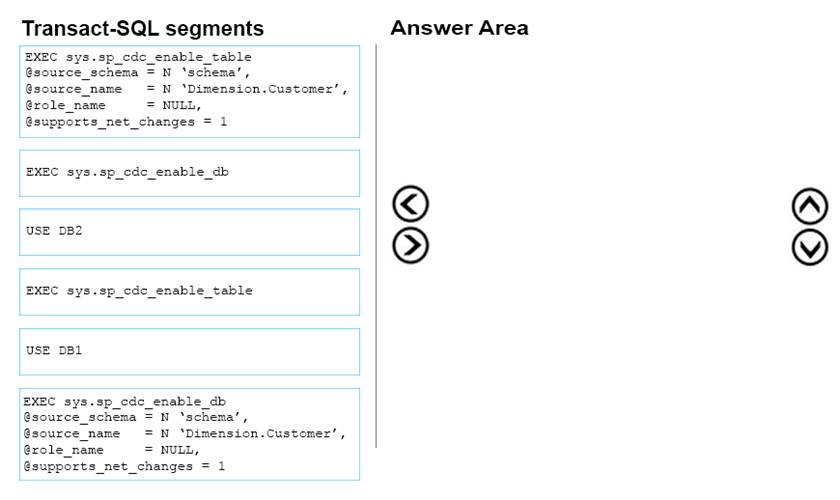
You need to optimize data loading for the Dimension.Customer table.
Which three Transact-SQL segments should you use to develop the solution? To answer, move the appropriate Transact-SQL segments from the list of Transact-SQL segments to the answer area and arrange them in the correct order.
NOTE: You will not need all of the Transact-SQL segments.

A. 
Explanation:
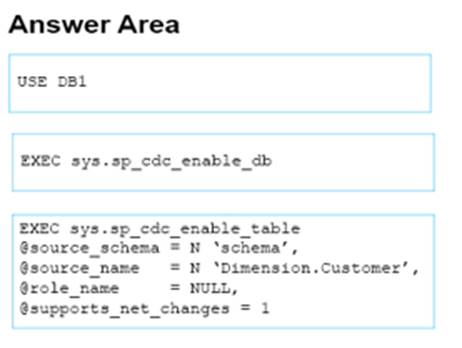
Step 1: USE DB1
From Scenario: All tables are in a database named DB1. You have a second database named DB2 that contains copies of production data for a development environment.
Step 2: EXEC sys.sp_cdc_enable_db
Before you can enable a table for change data capture, the database must be enabled. To enable the database, use the sys.sp_cdc_enable_db stored procedure.
sys.sp_cdc_enable_db has no parameters.
Step 3: EXEC sys.sp_cdc_enable_table
@source schema = N 'schema' etc.
Sys.sp_cdc_enable_table enables change data capture for the specified source table in the current database.
Partial syntax:
sys.sp_cdc_enable_table
[ @source_schema = ] 'source_schema',
[ @source_name = ] 'source_name' , [,[ @capture_instance = ] 'capture_instance' ]
[,[ @supports_net_changes = ] supports_net_changes ]
Etc.
References: https://docs.microsoft.com/en-us/sql/relational-databases/system-stored-procedures/sys-sp-cdc-enable-table-transact-sql
https://docs.microsoft.com/en-us/sql/relational-databases/system-stored-procedures/sys-sp-cdc-enable-db-transact-sql

問題#5

DRAG DROP
Note: This question is part of a series of questions that use the same scenario. For your convenience, the scenario is repeated in each question. Each question presents a different goal and answer choices, but the text of the scenario is exactly the same in each question in this series.
You have a Microsoft SQL Server data warehouse instance that supports several client applications.
The data warehouse includes the following tables: Dimension.SalesTerritory, Dimension.Customer, Dimension.Date, Fact.Ticket, and Fact.Order. The Dimension.SalesTerritory and Dimension.Customer tables are frequently updated. The Fact.Order table is optimized for weekly reporting, but the company wants to change it daily. The Fact.Order table is loaded by using an ETL process. Indexes have been added to the table over time, but the presence of these indexes slows data loading.
All data in the data warehouse is stored on a shared SAN. All tables are in a database named DB1. You have a second database named DB2 that contains copies of production data for a development environment. The data warehouse has grown and the cost of storage has increased. Data older than one year is accessed infrequently and is considered historical.
You have the following requirements:
- Implement table partitioning to improve the manageability of the data warehouse and to avoid the need to repopulate all transactional data each night. Use a partitioning strategy that is as granular as possible.
- - Partition the Fact.Order table and retain a total of seven years of data.
- - Partition the Fact.Ticket table and retain seven years of data. At the end of each month, the partition structure must apply a sliding window strategy to ensure that a new partition is available for the upcoming month, and that the oldest month of data is archived and removed.
- - Optimize data loading for the Dimension.SalesTerritory, Dimension.Customer, and Dimension.Date tables.
- - Incrementally load all tables in the database and ensure that all incremental changes are processed.
- - Maximize the performance during the data loading process for the Fact.Order partition.
- - Ensure that historical data remains online and available for querying.
- - Reduce ongoing storage costs while maintaining query performance for current data.
You are not permitted to make changes to the client applications.
You need to configure the Fact.Order table.
Which three actions should you perform in sequence? To answer, move the appropriate actions from the list of actions to the answer area and arrange them in the correct order.


A. 

Explanation:
From scenario: Partition the Fact.Order table and retain a total of seven years of data. Maximize the performance during the data loading process for the Fact.Order partition.
Step 1: Create a partition function.
Using CREATE PARTITION FUNCTION is the first step in creating a partitioned table or index.
Step 2: Create a partition scheme based on the partition function.
To migrate SQL Server partition definitions to SQL Data Warehouse simply:
Step 3: Execute an ALTER TABLE command to specify the partition function.
References: https://docs.microsoft.com/en-us/azure/sql-data-warehouse/sql-data-warehouse-tables-partition

試験コード: 70-767問題数量: 136 Q&As更新時間:  2019-04-09

  70-767フルバージョンを入手