Testpassport

 sales@testpassport.jp

下記はMicrosoft 70-762試験問題集は実際の試験問題のバージョンの一部です。 MCSA 70-762問題集 は実際の試験問題バージョンには157問になります。すべての実際の試験問題は、勉強者が最初の試みで成功することを保証できます。70-762問題集の実際の試験問題でMicrosoft試験に不合格になった場合、全額で支払い手数料の払い戻しを受けられます。実際の試験問題をトレーニングしたいでしょうか? では、トレーニングしましょう!

 70-762フルバージョンを入手

問題#1

Notify the sales person who places an order whether or not the order was completed.

You must add the following constraints to the SalesHistory table:
- a constraint on the SaleID column that allows the field to be used as a record identifier
- a constant that uses the ProductID column to reference the Product column of the ProductTypes table
- a constraint on the CategoryID column that allows one row with a null value in the column
- a constraint that limits the SalePrice column to values greater than four

Finance department users must be able to retrieve data from the SalesHistory table for sales persons where the value of the SalesYTD column is above a certain threshold.

You plan to create a memory-optimized table named SalesOrder.
The table must meet the following requirments:
- The table must hold 10 million unique sales orders.
- The table must use checkpoints to minimize I/O operations and must not use transaction logging.
- Data loss is acceptable.
Performance for queries against the SalesOrder table that use Where clauses with exact equality operations must be optimized.
You need to modify the design of the Orders table.
What should you create?

A. a stored procedure with the RETURN statement
B. a FOR UPDATE trigger
C. an AFTER UPDATE trigger
D. a user defined function

Explanation:
Requirements: You must modify the Orders table to meet the following requirements:
Create new rows in the table without granting INSERT permissions to the table.
Notify the sales person who places an order whether or not the order was completed.
References: https://msdn.microsoft.com/en-us/library/ms186755.aspx

問題#2

HOTSPOT
Note: This question is part of a series of questions that use the same scenario. For your convenience, the scenario is repeated in each question. Each question presents a different goal and answer choices, but the text of the scenario is exactly the same in each question in this series.
You have a database that contains the following tables: BlogCategory, BlogEntry, ProductReview, Product, and SalesPerson.
The tables were created using the following Transact SQL statements:
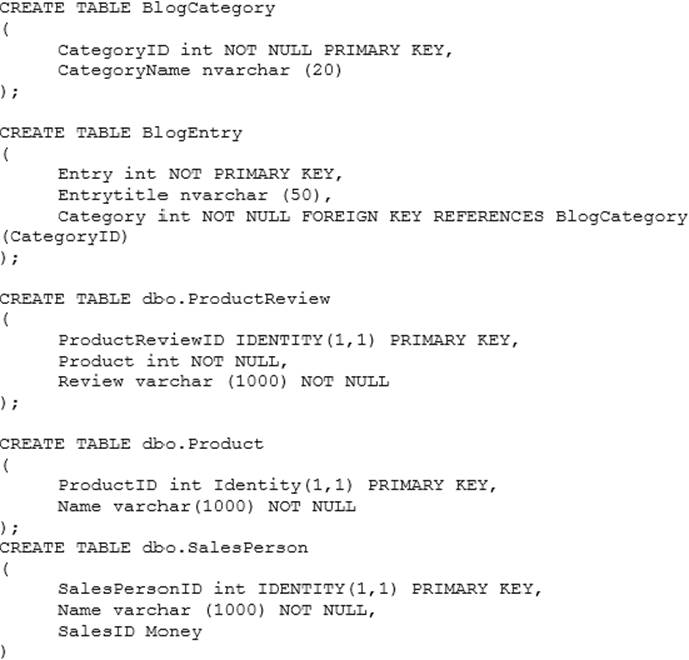


You must modify the ProductReview Table to meet the following requirements:
- The table must reference the ProductID column in the Product table
- Existing records in the ProductReview table must not be validated with the Product table.
- Deleting records in the Product table must not be allowed if records are referenced by the ProductReview table.
- Changes to records in the Product table must propagate to the ProductReview table.

You also have the following database tables: Order, ProductTypes, and SalesHistory, The transact-SQL statements for these tables are not available.

You must modify the Orders table to meet the following requirements:
- Create new rows in the table without granting INSERT permissions to the table.
- Notify the sales person who places an order whether or not the order was completed.

You must add the following constraints to the SalesHistory table:
- a constraint on the SaleID column that allows the field to be used as a record identifier
- a constant that uses the ProductID column to reference the Product column of the ProductTypes table
- a constraint on the CategoryID column that allows one row with a null value in the column
- a constraint that limits the SalePrice column to values greater than four

Finance department users must be able to retrieve data from the SalesHistory table for sales persons where the value of the SalesYTD column is above a certain threshold.

You plan to create a memory-optimized table named SalesOrder.
The table must meet the following requirements:
- The table must hold 10 million unique sales orders.
- The table must use checkpoints to minimize I/O operations and must not use transaction logging.
- Data loss is acceptable.

Performance for queries against the SalesOrder table that use Where clauses with exact equality operations must be optimized.
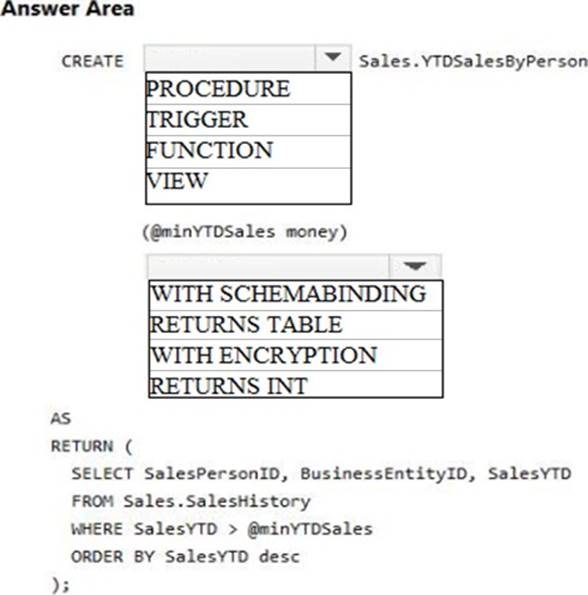
You need to create an object that allows finance users to be able to retrieve the required data. The object must not have a negative performance impact.
How should you complete the Transact-SQL statements? To answer, select the appropriate Transact-SQL segments in the answer area.

A. 

Explanation:
A user defined function can return a table, which can be produces by a SELECT statement.
From question : Finance department users must be able to retrieve data from the SalesHistory table for sales persons where the value of the SalesYTD column is above a certain threshold.
Incorrect:
Not VIEW: The RETURN clause is not used when you create a view.
References: https://docs.microsoft.com/en-us/sql/t-sql/statements/create-function-transact-sql?view=sql­server-2017

問題#3

HOTSPOT
Note: This question is part of a series of questions that use the same scenario. For your convenience, the scenario is repeated in each question. Each question presents a different goal and answer choices, but the text of the scenario is exactly the same in each question in this series.
You have a database that contains the following tables: BlogCategory, BlogEntry, ProductReview, Product, and SalesPerson.
The tables were created using the following Transact SQL statements:

70-762(V62

You must modify the ProductReview Table to meet the following requirements:
- The table must reference the ProductID column in the Product table
- Existing records in the ProductReview table must not be validated with the Product table.
- Deleting records in the Product table must not be allowed if records are referenced by the ProductReview table.
- Changes to records in the Product table must propagate to the ProductReview table.

You also have the following database tables: Order, ProductTypes, and SalesHistory, The transact-SQL statements for these tables are not available.

You must modify the Orders table to meet the following requirements:
- Create new rows in the table without granting INSERT permissions to the table.
- Notify the sales person who places an order whether or not the order was completed.

You must add the following constraints to the SalesHistory table:
- a constraint on the SaleID column that allows the field to be used as a record identifier
- a constant that uses the ProductID column to reference the Product column of the ProductTypes table
- a constraint on the CategoryID column that allows one row with a null value in the column
- a constraint that limits the SalePrice column to values greater than four

Finance department users must be able to retrieve data from the SalesHistory table for sales persons where the value of the SalesYTD column is above a certain threshold.

You plan to create a memory-optimized table named SalesOrder.
The table must meet the following requirements:
- The table must hold 10 million unique sales orders.
- The table must use checkpoints to minimize I/O operations and must not use transaction logging.
- Data loss is acceptable.

Performance for queries against the SalesOrder table that use Where clauses with exact equality operations must be optimized.
You need to enable referential integrity for the ProductReview table.
How should you complete the relevant Transact-SQL statement? To answer? select the appropriate Transact-SQL segments in the answer area.


A. 

Explanation:
Box 1: WITH NOCHECK
We should use WITH NOCHECK as existing records in the ProductReview table must not be validated with the Product table.
Box 2: ON DELETE NO ACTION ON DELETE NO CASCADE
Deletes should not be allowed, so we use ON DELETE NO ACTION.
Updates should be allowed, so we use ON DELETE NO CASCADE
NO ACTION: the Database Engine raises an error, and the update action on the row in the parent table is rolled back.
CASCADE: corresponding rows are updated in the referencing table when that row is updated in the parent table.
Note: ON DELETE { NO ACTION | CASCADE | SET NULL | SET DEFAULT }
Specifies what action happens to rows in the table that is altered, if those rows have a referential relationship and the referenced row is deleted from the parent table. The default is NO ACTION.
ON UPDATE { NO ACTION | CASCADE | SET NULL | SET DEFAULT }
Specifies what action happens to rows in the table altered when those rows have a referential relationship and the referenced row is updated in the parent table. The default is NO ACTION.
Note: You must modify the ProductReview Table to meet the following requirements:

問題#4

DRAG DROP
Note: This question is part of a series of questions that use the same scenario. For your convenience, the scenario is repeated in each question. Each question presents a different goal and answer choices, but the text of the scenario is exactly the same in each question in the series.
You have a database named Sales that contains the following database tables. Customer, Order, and Products.
The Products table and the order table shown in the following diagram.


The Customer table includes a column that stores the date for the last order that the customer placed. You plan to create a table named Leads. The Leads table is expected to contain approximately 20,000 records. Storage requirements for the Leads table must be minimized.
You need to begin to modify the table design to adhere to third normal form.
Which column should you remove for each table? To answer? drag the appropriate column names to the correct locations. Each column name may be used once, more than once, or not at all. You may need to drag the split bar between panes or scroll to view content.


A. 

Explanation:
In the Products table the SupplierName is dependant on the SupplierID, not on the ProductID. In the Orders table the ProductName is dependant on the ProductID, not on the OrderID.
Note:
A table is in third normal form when the following conditions are met:
- It is in second normal form.
- All nonprimary fields are dependent on the primary key.
Second normal form states that it should meet all the rules for First 1Normnal Form and there must be no partial dependences of any of the columns on the primary key.
First normal form (1NF) sets the very basic rules for an organized database:
- Define the data items required, because they become the columns in a table. Place related data items in a table.
- Ensure that there are no repeating groups ofdata.
- Ensure that there is a primary key.
References: https://www.tutorialspoint.com/sql/third-normal-form.htm

問題#5

HOTSPOT
Note: This question is part of a series of questions that use the same scenario. For your convenience, the scenario is repeated in each question. Each question presents a different goal and answer choices, but the text of the scenario is exactly the same in each question in this series.
You have a database named Sales that contains the following database tables: Customer, Order, and Products.
The Products table and the Order table are shown in the following diagram.


The customer table includes a column that stores the data for the last order that the customer placed.
You plan to create a table named Leads. The Leads table is expected to contain approximately 20,000 records. Storage requirements for the Leads table must be minimized.
You need to modify the database design to meet the following requirements:
- Rows in the Orders table must always have a valid value for the ProductID column.
- Rows in the Products table must not be deleted if they arepart of any rows in the Orders table.
- All rows in both tables must be unique.
In the table below, identify the constraint that must be configured for each table.
NOTE: Make only one selection in each column.


A. 

Explanation:
A FOREIGN KEY in one table points to a PRIMARY KEY in another table. Here the foreign key constraint is put on the ProductID in the Orders, and points to the ProductID of the Products table. With a check constraint on the ProductID we can ensure that the Products table contains only unique rows.
References: http://www.w3schools.com/sql/sql_foreignkey.asp

試験コード: 70-762問題数量: 157 Q&As更新時間:  2021-01-29

  70-762フルバージョンを入手