Testpassport

 sales@testpassport.jp

下記はMicrosoft 70-483試験問題集は実際の試験問題のバージョンの一部です。 MCSD 70-483問題集 は実際の試験問題バージョンには288問になります。すべての実際の試験問題は、勉強者が最初の試みで成功することを保証できます。70-483問題集の実際の試験問題でMicrosoft試験に不合格になった場合、全額で支払い手数料の払い戻しを受けられます。実際の試験問題をトレーニングしたいでしょうか? では、トレーニングしましょう!

 70-483フルバージョンを入手

問題#1

You are creating a console application by using C#.
You need to access the application assembly.
Which code segment should you use?

A. Assembly.GetAssembly(this);
B. this.GetType();
C. Assembly.Load();
D. Assembly.GetExecutingAssembly();

Explanation:
Assembly.GetExecutingAssembly - Gets the assembly that contains the code that is currently executing.
Reference: http://msdn.microsoft.com/en-us/library/system.reflection.assembly.getexecutingassembly(v=vs.110).aspx
Incorrect:
Not A: Assembly.GetAssembly - Gets the currently loaded assembly in which the specified class is defined.
http://msdn.microsoft.com/en-us/library/system.reflection.assembly.getassembly.aspx

問題#2

You are implementing a method named Calculate that performs conversions between value types and reference types.
The following code segment implements the method. (Line numbers are included for reference only.)


You need to ensure that the application does not throw exceptions on invalid conversions.
Which code segment should you insert at line 04?

A. int balance = (int) (float)amountRef;
B. int balance = (int)amountRef;
C. int balance = amountRef;
D. int balance = (int) (double) amountRef;

Explanation:
Explicit cast of object into float, and then another Explicit cast of float into int.
Reference: explicit (C# Reference)
https://msdn.microsoft.com/en-us/library/xhbhezf4.aspx

問題#3

You are creating a class named Employee. The class exposes a string property named EmployeeType.
The following code segment defines the Employee class. (Line numbers are included for reference only.)
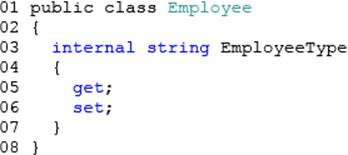


The EmployeeType property value must be accessed and modified only by code within the Employee class or within a class derived from the Employee class.
You need to ensure that the implementation of the EmployeeType property meets the requirements.
Which two actions should you perform? (Each correct answer represents part of the complete solution. Choose two.)

A. Replace line 05 with the following code segment: protected get;
B. Replace line 06 with the following code segment: private set;
C. Replace line 03 with the following code segment: public string EmployeeType
D. Replace line 05 with the following code segment: private get;
E. Replace line 03 with the following code segment: protected string EmployeeType
F. Replace line 06 with the following code segment: protected set;

Explanation:
protected string EmpType { get; private set;}
This is a quite common way to work with properties within base classes.
Incorrect:
Not D: Cannot be used because of the internal keyword on line 03.

問題#4

You are developing an application by using C#.
The application includes an object that performs a long running process.
You need to ensure that the garbage collector does not release the object's resources until the process completes.
Which garbage collector method should you use?

A. ReRegisterForFinalize()
B. SuppressFinalize()
C. Collect()
D. WaitForFullGCApproach()

Explanation:
You can use the SuppressFinalize method in a resource class to prevent a redundant garbage collection from being called.
Reference: GC.SuppressFinalize Method (Object)
https://msdn.microsoft.com/en-us/library/system.gc.suppressfinalize(v=vs.110).aspx

問題#5

You are developing an application that will convert data into multiple output formats.
The application includes the following code. (Line numbers are included for reference only.)


You are developing a code segment that will produce tab-delimited output.
All output routines implement the following interface:


You need to minimize the completion time of the GetOutput() method.
Which code segment should you insert at line 06?


A. Option A
B. Option B
C. Option C
D. Option D

Explanation:
A String object concatenation operation always creates a new object from the existing string and the new data.
A StringBuilder object maintains a buffer to accommodate the concatenation of new data. New data is appended to the buffer if room is available; otherwise, a new, larger buffer is allocated, data from the original buffer is copied to the new buffer, and the new data is then appended to the new buffer.
The performance of a concatenation operation for a String or StringBuilder object depends on the frequency of memory allocations. A String concatenation operation always allocates memory, whereas a StringBuilder concatenation operation allocates memory only if the StringBuilder object buffer is too small to accommodate the new data. Use the String class if you are concatenating a fixed number of String objects. In that case, the compiler may even combine individual concatenation operations into a single operation. Use a StringBuilder object if you are concatenating an arbitrary number of strings; for example, if you're using a loop to concatenate a random number of strings of user input.
http://msdn.microsoft.com/en-us/library/system.text.stringbuilder(v=vs.110).aspx

試験コード: 70-483問題数量: 288 Q&As更新時間:  2019-05-29

  70-483フルバージョンを入手