Testpassport

 sales@testpassport.jp

下記はMicrosoft 70-461試験問題集は実際の試験問題のバージョンの一部です。 MCSE 70-461問題集 は実際の試験問題バージョンには232問になります。すべての実際の試験問題は、勉強者が最初の試みで成功することを保証できます。70-461問題集の実際の試験問題でMicrosoft試験に不合格になった場合、全額で支払い手数料の払い戻しを受けられます。実際の試験問題をトレーニングしたいでしょうか? では、トレーニングしましょう!

 70-461フルバージョンを入手

問題#1

HOTSPOT
You have a database that contains the following related tables:


You create a view named OrderSummary by using the following Transact-SQL statement: For each of the following statements, select Yes if the statement is true. Otherwise, select No.


A. 

Explanation:
The SalesOrderID column is used in a join statement and cannot be updated. The Status column is used can be updated. The SubTotal column is an aggregate column and cannot be updated.

問題#2

DRAG DROP
You use Microsoft SQL Server client tool to develop a Microsoft Azure SQL Database instance to support an e-commerce application.
The database consists of a Product table, a Store table, and a StoreProduct table as shown in the exhibit. (Click the Exhibit button.)
You need to write a trigger that meets the following requirements:
- Stores are not physically deleted, but are marked as deleted.
- When a store is deleted, the products that are sold in that store are marked as discontinued.
Which four Transact-SQL segments should you use to develop the solution? To answer, move the appropriate Transact-SQL segments from the list of Transact-SQL segments to the answer area and arrange them in the correct order.
Exhibit


A. 

問題#3

DRAG DROP
You develop a Microsoft SQL Server Database.
The database contains a table named Status that is defined by the following Transact-SQL statement:


There are thousands of rows in the Status table, with significant duplication of data in the Color column. Ninety percent of the rows in the table have Color="Red", and the remaining 10 percent have Color="Green".
You want to normalize the Color information in this table.
You create a table named Colors that is defined by the following DDL:


You populate the new Colors table by using the following Transact-SQL statement:
INSERT Colors (ColorName) SELECT DISTINCT Color FROM Status
You need to ensure that the following requirements are met:
- The Status table uses only colors that exist in the Colors table.
- Data redundancy in the Status table is reduced.
- Data integrity is enforced during the normalization process.
Which three Transact-SQL segments should you use to develop the solution? To answer, move the appropriate Transact-SQL segment from the list of Transact-SQL segments to the answer area and arrange them in the correct order.


A. 

Explanation:
First update the new column ColorID, and drop the old Column Color.
Add a check constraint on the new ColorID column, and finally add a foreign key constraint.

問題#4

Note: This question is part of a series of questions that use the same set of answer choices. An
answer choice may be correct for more than one question in the series.
You develop a database for a travel application. You need to design tables and other database objects.
You create the Historical_Events table.
You need to store dates by using the smallest possible storage size.
What should you do?

A. Use the CAST function.
B. Use the DATE data type.
C. Use the FORMAT function.
D. Use an appropriate collation.
E. Use a user-defined table type.
F. Use the VARBINARY data type.
G. Use the DATETIME data type.
H. Use the DATETIME2 data type.
I. Use the DATETIMEOFFSET data type.
J. Use the TODATETIMEOFFSET function.

Explanation:
The size of a column with the DATE format is 3 bytes fixed.

問題#5

Note: This question is part of a series of questions that use the same set of answer choices. An answer choice may be correct for more than one question in the series.
You develop a database for a travel application. You create a view that displays details of events and
attractions. The names of the event and attractions are sorted alphabetically.
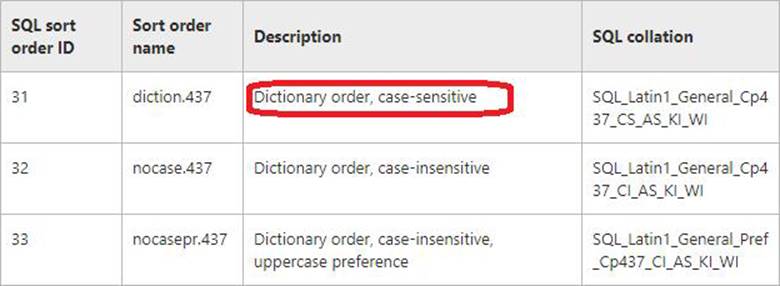
You need to sort the names in a case-sensitive, dictionary order.
What should you do?

A. Use the CAST function.
B. Use the DATE data type.
C. Use the FORMAT function.
D. Use an appropriate collation.
E. Use a user-defined table type.
F. Use the VARBINARY data type.
G. Use the DATETIME data type.
H. Use the DATETIME2 data type.
I. Use the DATETIMEOFFSET data type.
J. Use the TODATETIMEOFFSET function.

Explanation:
This topic describes SQL Server 2008 collation options for instances of SQL Server that require compatibility with versions of SQL Server that do not use collations.
The following SQL collations are listed on the Collation Settings page of the SQL Server Installation Wizard.


References: https://msdn.microsoft.com/it-it/library/ms144250(v=sql.105).aspx

試験コード: 70-461問題数量: 232 Q&As更新時間:  2019-06-29

  70-461フルバージョンを入手